Types of hernia
Most hernias develop in the tummy (abdomen) or groin (where your legs join your abdomen). Some cause a lump under your skin, while others are internal and cannot be seen.
Some improve on their own but others may need surgery.
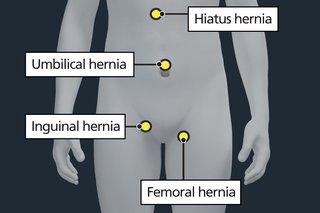
| Type of hernia | Where it happens |
|---|---|
|
In your chest |
|
|
Under or near your belly button |
|
|
Where your leg joins your abdomen (groin) |
|
|
In your upper thigh, near your groin |
|
|
Lumbar hernia |
In or near your spine |
|
Stoma hernia |
Under or near a stoma (a stoma is where part of your bowel or bladder is brought through an opening that's been made in your tummy) |
Symptoms of a hernia
The symptoms caused by a hernia depend on where it is and how long you've had it.
Some common symptoms of a hernia include:
- a bulge or lump where the hernia is, such as where your legs join your abdomen (groin), upper thigh or tummy – the lump may get bigger when you cough, sneeze or cry, and get smaller when you lie down
- the skin over the lump seeming tight and stretched
- a heavy, dragging feeling in your leg from a femoral or inguinal hernia
- indigestion symptoms such as heartburn or reflux from a hiatus hernia
- pain in or around the hernia, usually with smaller hernias – this can be a sign of strangulation, when your muscle tightens around your internal organs
Although a large hernia may look uncomfortable, it may not be painful because the weak area of muscles becomes stretched, allowing the hernia to pass through it easily.
Non-urgent advice: See a GP if:
- you think you have a hernia
They may refer you for tests or treatment if needed.
Urgent advice: Get help from NHS 111 if:
You have a hernia and:
- pain in or around the hernia
- a bloated tummy
- you feel sick (nausea) or you're being sick (vomiting)
- you're vomiting blood or your vomit looks like coffee grounds
- you're constipated
- you have a high temperature, or you feel hot, cold or shivery
- you've suddenly become confused
You can call 111 or get help from 111 online.
Treatment for a hernia
The treatment you're offered for your hernia depends on the type you have, what caused it, and whether it's a new hernia or it's come back after treatment.
Possible treatment for a hernia include:
- medicines to help the indigestion symptoms of a hiatus hernia
- losing weight, if you're overweight
- surgery to repair the hernia
How to prevent a hernia
You cannot always prevent a hernia, but there are things you can do to reduce your chance of getting some types.
Do
-
try to lose weight if you're overweight, and keep to a healthy weight
-
be physically active – aim for at least 150 minutes of moderate activity or 75 minutes of vigorous activity a week
-
try to quit smoking, if you smoke
-
see a GP if you have a cough that does not get better or keeps coming back
Page last reviewed: 19 May 2026
Next review due: 19 May 2029