Good hygiene is very important when making up a formula feed.
Your baby's immune system is not as strong as an adult's. That's why bottles, teats and any other feeding equipment need to be washed and sterilised before each feed.
This will reduce the chance of your baby getting an infection, in particular diarrhoea and vomiting.
Step-by-step guide to preparing a formula feed
- Step 1: Fill the kettle with at least 1 litre of fresh tap water (do not use water that has been boiled before).
- Step 2: Boil the water. Then leave the water to cool for no more than 30 minutes, so that it remains at a temperature of at least 70C.
- Step 3: Clean and disinfect the surface you are going to use.
- Step 4: It's important that you wash your hands.
- Step 5: If you are using a cold-water steriliser, shake off any excess solution from the bottle and the teat, or rinse them with cooled boiled water from the kettle (not tap water).
- Step 6: Stand the bottle on the cleaned, disinfected surface.
- Step 7: Follow the manufacturer's instructions and pour the amount of water you need into the bottle. Double check that the water level is correct. Always put the water in the bottle first, while it is still hot, before adding the powdered formula.
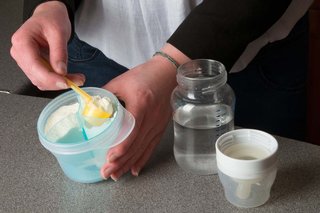
- Step 8: Loosely fill the scoop with formula powder, according to the manufacturer's instructions, then level it using either the flat edge of a clean, dry knife or the leveller provided. Different formulas come with different scoops. Make sure you only use the scoop that comes with the formula.
- Step 9: Holding the edge of the teat, put it into the retaining ring, check it is secure, then screw the ring tightly onto the bottle. Make sure the ring is attached firmly.
- Step 10: Cover the teat with the cap and shake the bottle until the powder is dissolved.
- Step 11: It's important to cool the formula so it's not too hot to drink. Do this by holding the bottle (with the lid on) under cold running water.
- Step 12: Test the temperature of the formula on the inside of your wrist before giving it to your baby. It should be body temperature, which means it should feel warm or cool, but not hot.
- Step 13: If there is any made-up formula left in the bottle after a feed, throw it away.
Using a baby formula preparation machine
If you use a baby formula preparation machine, follow the manufacturer's instructions.
Make sure the water that comes out of the machine is at least 70C when it’s mixed with the formula powder. You can use a digital food thermometer to check this. Water at 70C or more will kill any harmful bacteria.
If the water is less than 70C, stop using the machine and follow the step-by-step guide to preparing formula feed instead.
You may also want to contact the manufacturer, your local Trading Standards office or Citizens Advice to report a fault with your machine.
Dos and don'ts of making up formula feeds
- Do follow the manufacturer's instructions very carefully, as they vary as to how much water and powder to use.
- Do not add extra formula powder when making up a feed. This can make your baby constipated or dehydrated.
- Do not add extra water when making up a feed. Too little powder may not give your baby enough nourishment.
- Do not add sugar or cereals to your baby's formula.
- Never warm up formula in a microwave, as it may heat the feed unevenly and burn your baby's mouth.
Reducing the risk of infection
Even when tins and packets of powdered infant formula are sealed, they can sometimes contain bacteria.
Bacteria multiply very fast at room temperature. Even when a feed is kept in a fridge, bacteria can still survive and multiply, although more slowly.
To reduce the risk of infection, it's best to make up feeds 1 at a time, as your baby needs them.
Use freshly boiled drinking water from the tap to make up a feed. Do not use artificially softened water or water that has been boiled before.
Leave the water to cool in the kettle for no more than 30 minutes. Then it will stay at a temperature of at least 70C. If you’re using a baby formula preparation machine, make sure the water is at least 70C. Water at this temperature will kill any harmful bacteria.
Remember to let the feed cool before you give it to your baby. Or you can hold the bottle (with the lid on) under cold water from the tap.
Can I use bottled water to make up infant formula feeds?
Bottled water is not usually recommended for making up infant formula feeds for your baby. This is because it's not sterile and may contain too much salt (sodium) or sulphate.
But in rare circumstances, such as when drinking water is unavailable or has been contaminated, you can use bottled water to make up infant formula feeds.
You still need to follow the step-by-step guide when making up infant formula and any additional advice provided by the Food Standards Agency (FSA) or UK Health Security Agency (UKHSA).