Why amniocentesis is done
Amniocentesis is a test to check if your baby has a genetic condition such as:
- Down's syndrome
- Edwards' syndrome
- Patau's syndrome
- sickle cell disease
- thalassaemia
- cystic fibrosis
If you're offered amniocentesis, it's usually done between 15 and 20 weeks of pregnancy, but it can be done later.
There is a similar test called chorionic villus sampling (CVS) that may be offered instead of amniocentesis.
Your midwife or doctor can explain why you're being offered amniocentesis and what the results might mean, and help you decide whether it's right for you.
Who may be offered amniocentesis
You may be offered amniocentesis if your baby has a higher chance of having certain conditions that will affect their health and development.
Amniocentesis may be offered if:
- a screening test in pregnancy shows your baby may have one of the conditions being tested for
- you've had a previous pregnancy or baby affected by one of the conditions that amniocentesis checks for
- you, the baby's father, or a close relative have one of the conditions that amniocentesis checks for
How amniocentesis is done
Amniocentesis is done by a doctor who specialises in care during pregnancy (an obstetrician). The procedure is usually done in hospital and takes about 10 minutes.
Let them know if you would like someone else to be in the room with you (a chaperone) – this could be someone you know, or a doctor, nurse or trained member of staff.
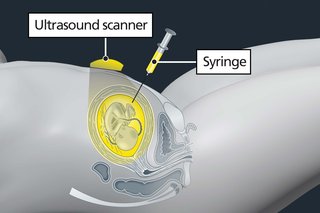
- You'll have an ultrasound scan so the doctor can see your baby on a screen throughout the procedure.
- Your tummy is wiped with antiseptic.
- A thin needle is inserted through your tummy into your womb (uterus) using the ultrasound image to guide the needle. This may feel uncomfortable but should not be painful.
- A small sample of the fluid around your baby (amniotic fluid) is collected using the needle.
- The needle is carefully removed from your tummy.
- The sample is sent to a lab for testing.
If you're having more than one baby, the doctor may need to get samples from the fluid around each baby.
Tell the healthcare professional doing your blood test if you're worried about needles. They can help you feel more comfortable during the test.
After amniocentesis
After amniocentesis, you may have a tummy ache. This is normal and usually happens within the first or second day after the procedure. You can take paracetamol to help.
Try to rest after the procedure and for the next day if possible.
If your blood type is rhesus negative (A-, B-, AB- or O-), you'll be offered an injection to protect your baby from a condition called haemolytic disease of the foetus and newborn (HDFN).
Possible risks of amniocentesis
As with any procedure there are risks of having amniocentesis. Your maternity team will discuss these with you to help you decide whether to have it.
Miscarriage
There is a risk of miscarriage (loss of a pregnancy) after having amniocentesis.
The risk of miscarriage is 1 in every 200 pregnancies. If you're pregnant with twins or more, the risk of miscarriage is higher.
Most miscarriages after amniocentesis happen within 3 days of having the procedure but it can happen up to 2 weeks after.
Passing HIV, or hepatitis B or C on to your baby
If you're HIV positive, or have hepatitis B or hepatitis C, having amniocentesis may increase the risk of passing the infection on to your baby.
The doctor or specialist team caring for you can discuss the risk with you.
Infection
Rarely, amniocentesis may cause an infection. The risk of infection is fewer than 1 in 1,000 procedures.
Urgent advice: Get urgent medical help if:
You've had amniocentesis and you have:
- pain in your tummy that does not get better with paracetamol – the pain might be there all the time, or it may stop and start
- fluid coming from your vagina
- a high temperature, or you feel hot, cold or shivery
- vaginal bleeding
- contractions (cramping tummy pain that comes and goes)
Call your maternity unit if you have the phone number.
If you do not have a maternity unit yet or cannot call them, ask your GP for an urgent appointment.
If you cannot contact a maternity unit or GP, call NHS 111.
Getting your amniocentesis results
After having amniocentesis, you'll get the results for Down's syndrome, Edwards' syndrome and Patau's syndrome in around 3 working days.
If your baby is being tested for other conditions, the results may take around 2 weeks.
You can usually choose to get your results by phone or in person during an appointment.
If your baby has a condition
If the results show your baby has a condition, your doctor and midwife will talk with you about how this may affect you and your baby.
You'll be offered advice and support to help you decide whether to continue with your pregnancy or to end it by having a termination (abortion).
Find out what happens if you:
Get support
Antenatal Results and Choices (ARC) has information about screening tests and how you might feel if you're told your baby has, or might have, a condition.
Their helpline is open Monday to Friday, 10am to 5.30pm. Call 020 7713 7486.
You can also get more information and support from charities for some of the main conditions amniocentesis tests for: