Club foot 

Introduction 

Club foot

Vanessa and Jon's daughter was born with club feet. They describe coping with the diagnosis and choosing her treatment, and an expert compares physiotherapy with surgery.

Talipes

Club foot is sometimes known as talipes. There are two types of talipes:

  • congenital talipes equinovarus (club foot)
  • talipes calcaneovalgus – where the foot points upwards and outwards

This topic focuses on congenital club foot.

Club foot is a deformity of the foot and ankle that is present at birth (congenital).

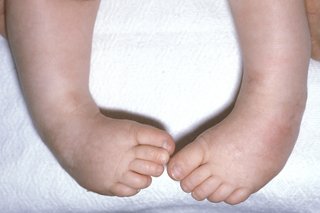
In a baby born with club foot, the foot points down and inwards with deep inner and heel creases. In cases where both feet are affected, the soles of the feet face each other. Both feet are affected in around half of all cases of club foot.

What causes club foot?

Club foot occurs when the muscles on the outer side of the leg are weaker than those on the inside of the leg. The tendons on the inside of the leg also become shorter than normal.

Tendons are the tough cords that connect muscles to bones. In club foot, the bones of the foot are abnormally shaped and the Achilles tendon (the large tendon at the back of the heel) is tight.

In most cases the cause of club foot is unknown, but it occasionally runs in the family. If you have had a child with club foot, you are 20 times more likely to have another child with the condition.

Read more about the causes of club foot.

The Ponseti method

A baby with club foot will not usually experience any pain and treatment is often effective in correcting the abnormal position of their feet.

Ideally, treatment for club foot will start within a week or two of the baby being born. A treatment technique known as the Ponseti method is the main treatment for club foot, which involves your baby's foot being gently manipulated into position and put in a cast.

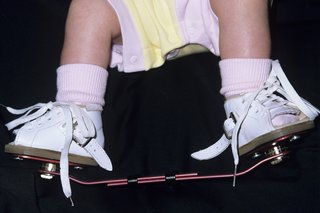
This is repeated several times over a number of weeks (the average time is five weeks). After this, your baby will need to wear special boots that are attached to a bar until they are about four years of age.

Although it is sometimes a difficult process to go through, the Ponseti method is effective in treating around 85% of babies with club foot. It is important to stick to the treatment to prevent club foot re-occurring.

Your child’s condition will be regularly reviewed in case they have a relapse and require further treatment. However, provided that the condition is treated early, there should be few long-term side effects.

If club foot is treated when a baby is very young, the position and function of the foot is usually corrected and the child will not experience any painful symptoms. However, in some cases of club foot, long-term pain can occur despite continued treatment and corrective surgery.

Read more about treating club foot

How common is club foot?

Club foot affects one baby in every 1,000 born in the UK. It is one of the most common abnormalities that is present at birth, and it is twice as common in boys than in girls.

Last reviewed: 23/06/2011

Next review due: 23/06/2013

Ratings

How helpful is this page?

Average rating

Based on 26 ratings

All ratings

Add your rating

Comments are personal views. Any information they give has not been checked and may not be accurate.

Jacx said on 14 December 2011

Having been born in the sixties with club foot I was horrified to read that you are stating that club foot isn't painful. I definitely think that the article needs reviewing as it is giving a false impression to new parents with children with clubfoot. After having various surgeries I still have no movement in my club foot it is 2 sizes smaller than my other and leg length difference is substantial causing a knock on affect on the rest of my body. I live with constant pain/ discomfort and I am horrified by the insensitivity of this article. It just goes to prove the struggles that those born with clubfoot continue to fight against in showing the medical world along with benefits agencies and workforce that clubfoot isn't something that is cured in childhood but has an affect on the person throughout life both through pain, inability to carry out certain daily living tasks and ignorance of general public and professionals in recognizing clubfoot as a disibility that isn't cured but is managed as best as possible.

Report this content as offensive or unsuitable

BillyJoel88 said on 06 December 2011

I totally disagree with this saying, talipes is not painful!!! Clearly this was written by someone who doesn't have this disability. Or it could have been written by a consultant who's too stubborn to say its painful because they're in charge of correcting the feet with numerous operations.

I was born with talipes and i have suffered with pain for 23 years. Having op after op.
I have noticed the pain starting to get much worse as i have grown up. Especially in cold weather!
Another thing is, where there's pain, it stops me from doing things that i would like to do, like play football or exercise. Which, if i'm being totally honest. Gets me down! So really its a mental and physical pain.

Also i hate the fact that talipes is just brushed off by DLA.

Report this content as offensive or unsuitable

shiney9 said on 29 November 2011

Another thing that disturbs me about this 'claim' that clubfeet aren't painful is that if employers of people with this condition believe this content in preference to what their employees are saying about pain, discomfort, inability to stand too long, walk too far, carry heavy things or negotiate uneven ground. These are things that happen to me every day and I can't work at present. Please, someone, maybe the author of this page, get your facts right! You are really doing a disservice to thousands of people. Spend a day in my shoes and tell me about painless clubfeet!

Report this content as offensive or unsuitable

Willy Kiyotte said on 28 November 2011

I see you are deleting a number of comments that do not agree with the statement on this page, that club feet are "not painful." Do you think we are bad for business, or what? Please justify your censorship, as nothing anyone has so far posted constitutes personal info, libel, abuse of privilege, etc. Why are you afraid to tell parents whose child is born with club feet the truth?

Report this content as offensive or unsuitable

Willy Kiyotte said on 28 November 2011

Just recieved this: "Thank you for contributing to the NHS Choices website. We have removed your contribution because you have revealed information about yourself or your family that may allow you to be identified and/or located. This puts your safety at risk and the NHS Choices website will not allow you to reveal personal information about yourself or others. " and I for the life of me cannot figure out what was "personal Information" in my prior post. I put no phone, address, web site, email, nothing personal. Or, is the Moderator rejecting my comment because I have a fundamental disagreement with the content I was commenting on? Are you, the NHS, so afraid of being questioned as to the veracity of your information? If so, how sad. Let me know if this comment has too much personal information.

Report this content as offensive or unsuitable

Galatea0426 said on 28 November 2011

I was born in 1964 in New Hartfor, New York in the USA. I have had over 20 operations to "correct" my bilateral club feet. Although I am very grateful to still be walking, to say that club feet is painless is a huge misnomer. My feet cause me chronic pain due to arthritis, scar tissue and a whole host of other things. I remember as a child having surgery every summer until I was in grade 10...and the pain was almost unbearable. Now, as a 47 year old woman, I am dealing with debilitating pain, and huge mobility issues. Please, if you want to know more, please join our group on Facebook called "Adults and Teens with Clubfeet." We are an articulate bunch, and a huge resource for great information and truth.

Thanks for listening!

Report this content as offensive or unsuitable

LucyWithClubFoot said on 27 November 2011

"Club foot is not painful and early treatment is usually effective in correcting the abnormal position of the feet. It is important to review the condition regularly as the child may have a relapse and need more treatment."

Not painful? That made me laugh. As a 21 year old who has Club Foot, it is incredibly painful. You get used to a dull pain and learn to cope, but a lot of the time it hurts a lot. My left foot straightened naturally but has no arch and a couple of fractures that don't heal, my right is still curved and I've had 4 (technically 6 but two surgeries were carried out at the same time, but have 6 scars) operations on my right foot. End product = limited foot and toe movement, chronic pain all over my foot, a flattened ankle joint, cold toes and finally, constant dread of more operations.


That's the medical stuff. As a child with a funny way of walking (until I was 6 I walked on the side of my foot) and up into my adult years, people find it funny to bully me about my foot. Not being able to run very well, jump or climb set me apart from my friends and just increased that bullying.

Please change this page, NHS, it's very painful and a huge thing. You don't belittle people with bad kidneys, don't belittle a severe issue.

Report this content as offensive or unsuitable

LucyWithClubFoot said on 27 November 2011

"Club foot is not painful and early treatment is usually effective in correcting the abnormal position of the feet. It is important to review the condition regularly as the child may have a relapse and need more treatment."

Not painful? That made me laugh. As a 21 year old who has Club Foot, it is incredibly painful. You get used to a dull pain and learn to cope, but a lot of the time it hurts a lot. My left foot straightened naturally but has no arch and a couple of fractures that don't heal, my right is still curved and I've had 4 (technically 6 but two surgeries were carried out at the same time, but have 6 scars) operations on my right foot. End product = limited foot and toe movement, chronic pain all over my foot, a flattened ankle joint, cold toes and finally, constant dread of more operations.


That's the medical stuff. As a child with a funny way of walking (until I was 6 I walked on the side of my foot) and up into my adult years, people find it funny to bully me about my foot. Not being able to run very well, jump or climb set me apart from my friends and just increased that bullying.

Please change this page, NHS, it's very painful and a huge thing. You don't belittle people with bad kidneys, don't belittle a severe issue.

Report this content as offensive or unsuitable

shiney9 said on 27 November 2011

How can the author of this page state that "Clubfoot is not painful?" I am genuinely agog at this statement! I was born, in 1959 with severe bi-lateral clubfeet. Memories are blurred from my early childhood, because children are so adept at blanking bad memories. I do remember much pain, and also sadness at being 'different' from others my age. I remember numerous (6+) long hospital stays for surgery and not being with my family. I never really got to know my younger brother as he was not allowed to visit me! That's pain too in case you didn't know and it definitely still pains me now! I am truly offended by the comments on this page. Also I find it unacceptable that so few people in the NHS have any understanding at all of Talipes Equinovarus. I understand that treatments have changed and that prospects are better now. But what about us? We are seemingly forgotten and you may just understand over the next few weeks, how many of us there are in constant daily pain from this severe disability. No wonder the DWP won't take any notice of us! Even the NHS don't know what they're talking about!

Report this content as offensive or unsuitable

er84 said on 27 November 2011

I was born with a clubfoot 27 years ago and I experience a life of daily pain. I have been refused a Freedom Pass and I have been refused DLA on the grounds I am not disabled.

Please tell me what it takes to be disabled if it means living with scars on your feet, very sore scar tissue, chronic cramping in the arch, an inability to move my toes on my clubfoot from surgery, tripping up stairs because of sudden loss of feeling down the leg, a much thinner leg on the clubfoot leg than on the normal leg, chronic fatugue from standing too much and chronic pain in the hips and lower back from the imbalance.

I have had to pay privately for years for physio and a chiropractor because my GP gave up giving me NHS physio... and still I receive nothing to compensate me for the pain and fatigue I experience on a daily basis.

Growing up apart from the nightmare of buying shoes and sandals... I was able to be active but when becoming an adult, all that changes we are not healed... this is when our problems become worse. My foot swells up after walking so much, my ankle still is red and covered in a rash... the scar tissue is still very sore and when I stand at 5'11 with a clubfoot size 4, it is hard to balance and grip on public transport but I still get refused disability support because I "look" normal.

I am not a scrounger, I work hard and I get up and go to work every day but I would love it if clubfoot was recognised as a disability so that I could get a seat on public transport and support with getting around when I cant manage the stairs or all that walking....

Report this content as offensive or unsuitable

jonathanhubbard said on 26 April 2011

A good review but very biased towards the best case scenario.

The Ponseti method is fantastic, it's helped our daughter no end. However in my opinion there are delays in my child's development - she is 11 months and not started crawling for example. She is still in pain when one stands her on her feet, suggesting another tenotomy will be required.

The casting and boots can be uncomfortable for the child, and can cause other issues such as colic, poor posture etc - my daugher has required approximately 7 chiropractor visits as a result.

Having said the above, if anyone reading this is unsure about using the Ponseti method please don't be. It is by far the best way to treat this in my opinion, a much better alternative to evasive surgery.

Report this content as offensive or unsuitable

Leg and foot problems in children

Common problems affecting the legs and feet of children under five

Find and Choose Hospitals for club foot