Slapped cheek syndrome 

Introduction 

Slapped cheek syndrome

Slapped cheek syndrome is a viral infection and the fifth most common disease in children. Here, a GP talks about the symptoms to look out for.

Advice for pregnant women

Ideally, a pregnant woman should avoid contact with any infected child. In practice this can be difficult as a child can be most contagious before their symptoms begin.

So there isn't much you can do to prevent yourself from getting the infection. But if you have been in close contact with a child who then goes on to develop slapped cheek syndrome, contact your GP for advice.

Slapped cheek syndrome (also known as “fifth disease”) is a type of viral infection that is most common in children, although it can affect anyone of any age. 

Slapped cheek syndrome usually affects children between the ages of 3 and 15. Most cases develop during the late winter months or early spring.

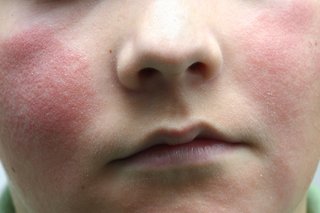
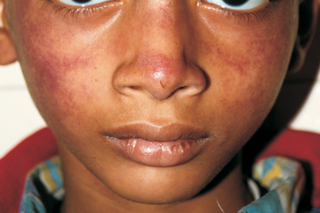
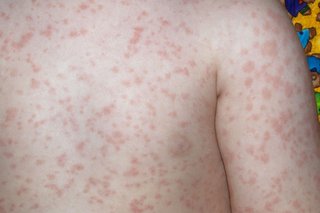
The most common symptom of slapped cheek syndrome is the appearance of a distinctive bright red rash on the cheeks. This is how the condition got its name.

You can read more about what the symptoms of slapped cheek syndrome are.

What treatment will my child need?

Most children will not need treatment as slapped cheek syndrome is usually a very mild condition that passes in a few days. Occasionally it can last up to four or five weeks.

Symptoms such as headaches, high temperature or itchy skin can usually be treated with over-the-counter medications such as paracetamol and antihistamines.

Adults who develop joint pain can use non-steroidal anti-inflammatory drugs (NSAIDs), such as ibuprofen, as painkillers.

You will probably only need to contact your GP if one or both of the following occurs:

  • Your (or your child’s) temperature rises to 39C or above.
  • Your (or your child’s) symptoms suddenly worsen.  

Read more about treating slapped cheek syndrome.

What are the causes of slapped cheek syndrome?

Slapped cheek syndrome is caused by a virus called parvovirus B19. Parvovirus B19 is an airborne virus that is spread in much the same way as the cold or flu viruses. It can be spread through coughs and sneezes that release tiny droplets of contaminated saliva which are then breathed in by another person.

It's very difficult to prevent the spread of the virus as people are most contagious before their symptoms begin, so they are unaware that they are infected.

Once you've been infected you should develop a lifelong immunity and not experience any further symptoms.

Read more about the causes of slapped cheek syndrome.

Complications

There are three high-risk groups in which the parvovirus B19 can cause a much more serious infection and trigger a range of complications. These are listed below.

  • People with certain blood disorders, such as sickle cell anaemia. This is where the blood doesn't contain enough healthy red blood cells (anaemia) and infection can lead to a further and more severe loss of red blood cells.
  • Pregnant women without immunity. Parvovirus B19 infection can increase the risk of a miscarriage because the virus can cause severe anaemia in the unborn child.
  • People with a weakened immune system (immunocompromised), either due to a side effect of treatment, such as chemotherapy, or from a condition such as HIV. These groups can experience prolonged, and sometime severe, symptoms of infection.

If you're in one of these high-risk groups and you have been in close contact with someone who goes on to develop slapped cheek syndrome, contact your GP for advice.

People in these groups may need to be admitted to hospital. In some cases, they may need a blood transfusion.

You can read more about the complications of slapped cheek syndrome.

  • show glossary terms


Last reviewed: 09/11/2011

Next review due: 09/11/2013

Ratings

How helpful is this page?

Average rating

Based on 329 ratings

All ratings

Add your rating

Comments are personal views. Any information they give has not been checked and may not be accurate.

Sheiladonegal said on 19 May 2013

I am a primary school teacher and have been off school for a few weeks because there is slapped cheek going around. I had the blood test done and was told that it came back negative meaning I was immune. This information was provided by a nurse over the phone. I actually phoned twice to double check result before I returned to school on Thursday. My husband told me to get the result in writing just to be certain and I collected it after school on Friday. However, when I read it, it said I was susceptible to ervyovirus b19. Underneath it said negative to parvovirus b19 igg level and igm level. I googled ervyovirus b19 and discovered this is another name for parvovirus! I immediately phoned the surgery and spoke to a doctor who said I was not immune to parvovirus b19. I was terribly upset as I only returned to work because I had been assured I was immune. The negative results meant I didn't currently have it and I didn't have any antibodies in my system for immunity. I now have to go and get a blood test in 4 wks to check if I picked it up in the 2 days I went back to work. I'm also stressing now about going back at all! With no immunity I'm terrified of contracting this (my first baby so anxious anyway). How am I meant to know if slapped cheek no longer in school, as I'm relying on parents to inform principal. Also some children aren't v unwell but still may have this in school. I rally don't want to go back but don't know if I'm covered to remain absent. Any suggestions welcome!!

Report this content as offensive or unsuitable

Cheery Mummy said on 09 May 2013

This condition was not mild for my 4 month old baby. His temperature kept reaching up to 39.5C over 6 days every 4 hrs. We had to call an ambulance 3 times and the hospital had to give medicine stronger than panadol to bring down the fever. It was scary.

Report this content as offensive or unsuitable

misszj said on 09 May 2013

my little boy was sent home yesterday from nursery with an suspicious rash, I was asked to have it checked out before bringing him back in as like any other school there is all sorts going around chicken pox etc... . so I went to my local walk in clinic to be told he had 'slap cheek' which until now iv never heard of. the doctor told me to allow him to have calpol if he had a temperature and to make sure he had plenty of fluids but not to keep him off school as that's where he most likely caught it from. I understand the concerns of other people on this page but after reading up on a few different sites its contagious even before the redness/rash appears on the face so you don't even realise you have it. I personally shall be keeping him off school for a few days to keep my eye on him but some people who take a doctors word and don't judge a situation for themselves then that child would be sent in. also the school is at fault as if that child is to be found to have something contagious then the school should have a policy in place of what illness's children are/ are not allowed in school with and for how long.

Report this content as offensive or unsuitable

Mungojerry said on 07 May 2013

The schools my children have been attending over the past ten years have always posted information notices when a case of slapped cheek was present at school. It seems like good practice. I too had never heard of it before having my own kids. Keeping the affected kids off school of course does not stop the spread or reduce the risk to others due to the earlier infective period. My youngest has now probably got the disease (hence being on this page) and she will be kept off until afebrile - but only for her good rather than to reduce spread. I agree that schools have a duty to inform. The NHS could develop public health to take a greater part in just-in-time education but in a recession when public services cuts are so harsh it is difficult to see that there will be any funding for expanding this area. This website is one of the great ways the public can get the information they need.

Report this content as offensive or unsuitable

jlt23 said on 17 March 2013

I have read the comments and feel that I have to tell you of my experience of slapped cheek. Especially noting 'Themanwhoknows' comments.
I have just returned from a week in hospital with my twins. They have a blood disorder that reacts to parvovirus. My daughter was given 20 minutes after being taken to hospital, my son luckily was caught early enough. Both had life saving transfusions.
Schools need to be aware that there are blood conditions which if are in contact with this virus, are life threatening.
If your child has slapped cheek please keep them at home until well. I almost lost my twins last week.
Perspective?

Report this content as offensive or unsuitable

susieu said on 09 March 2013

I was exposed to slapped cheek when I was 19-22 weeks pregnant by a friend's little boy. I got a blood test and called the receptionist to find out results after 5 days- she said the results came back 'normal- no further follow up'.
Does anyone know what 'normal' means? does this mean the blood test detected immunity? (I asked but she didn't know and I can't get an appointment with a doctor for another week!)
If it's no further follow up because they think I'm over 20 weeks (I'm 23 wks now), then I still want it to be followed up if I'm not immune!
Has anyone else had this blood test and knows what normal means please???
It's a 50% chance of being immune so either way could be classed as 'normal' really lol...I'm trying to stay on the bright side and think abnormal would mean something bad so this must be good right??

Report this content as offensive or unsuitable

Themanwhoknows said on 19 January 2013

My wife is a pregnant school teacher. One of her pupils contracted slap cheek. We read the below and panicked. The experiences outlined here are truly awful and I am truly sorry to the people effected. However to bring some perspective;
1) the vast majority of adults have immunity already.
2) Teachers have super immune systems due to coping with the vast array of childhood illness brought into the classroom daily.
3) Even if a pupil has slap cheek you are not automatically get it yourself.
4) If you are very unfortunate to contract it your immune system is highly capable of protecting your unborn baby.
5) Even in the unlikely event that it is passed to the baby only in very rare cases does it cause serious complications to the baby.
For peace of mind, you can if you like, go for a blood test, we did. Three anxious days later my wife was found to have the necessary antibodies and all is well. So please keep things in perspective, don't stress your baby unduly, the odds are stacked at everything being perfectly alright.

Report this content as offensive or unsuitable

PatiAnthony said on 25 November 2011

This seems to be quite a common virus, and our second son has now caught it going on the diagnosis. He did not, however, have a high temperature, and has had vomiting post the red-cheek phase. I am wondering if this is common?

Report this content as offensive or unsuitable

emma o said on 25 June 2011

hi i had parvovirous in pregnancy at 20 wks i had scans every wk and at 39 wks had a emergancy c section due to lack of movements. my daughter has had problems since and altho she is nearly 3 yrs old she is not walking and she has abtomalaties on right side of her brain and now has epalepsy sorry cant spell. so shes now on anti fittness drugs for life. even tho shes behind and cant walk i wouldnt change her for anything she is the most lovely gorgeous little girl.

Report this content as offensive or unsuitable

Megzo said on 26 January 2011

I am a secondary school teacher. Yesterday, I got a call from my headmaster to let me know that one of my pupils caught a virus which is harmful for pregnant women: Parvovirus.The pupil normally sits in front of me and I worked with her the day before the phone call. I was advised to contact my GP, which I did. I am going to be tested tomorrow. I hope that the stats will be on my side. I am 9 weeks pregnant and this is my first baby... I was told not to worry about it, everything will be fine. But, how is this possible? Of course, I am worried !!!

Report this content as offensive or unsuitable

Mam of Three said on 21 January 2011

I agree with yellowjewel999. My baby died at 19 weeks and 4 days because I caught this virus as a school teacher. I felt unwell at 16 weeks, went to the doctors twice, to be told I had 'a virus'. My school had confirmed cases, knew the risks, yet I was not told about them-they were not in my class! I feel let down that this virus is played down by health professionals. In 7 years of teaching I hadn't heard of it! It is a known risk and a common virus! 3-10% of pregnancies, under 20 weeks can die! Please raise awareness, if you know anyone who is pregnant, please inform of the dangers and get test to check immunity. My perfect baby girl died.

Report this content as offensive or unsuitable

yellowjewel999 said on 03 January 2011

Why aren't pregnant women routinely told about this???!!! There is no mention of it in my pregnancy book, my antenatal notes or blood test records and my midwives have never mentioned it to me. Nobody I know has ever even heard of this illness because nobody is ever informed of it! Something is clearly amiss in NHS practice and in public health policy!

Report this content as offensive or unsuitable

chrisandpam said on 15 December 2010

Very clear explanation of a virus I had never previously heard of until my grand-daughter was diagnosed

Report this content as offensive or unsuitable

Looking after a sick child

How to look after a sick child, including dealing with minor accidents and getting expert help

Medicines for children

Not all medicines are suitable for children. What to use to treat your sick child

Find and choose services for Slapped cheek syndrome