Cervical cancer 

Introduction 

Cervical cancer

Andy Nordin, a gynaecological oncologist, explains the symptoms of cervical cancer, who’s most at risk and the treatment options.

Cervical cancer community

Access Jo's Cervical Cancer Trust online forum and take part in the discussion

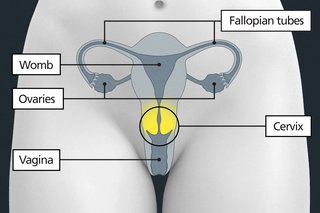
Cervical cancer is an uncommon type of cancer that develops in a woman’s cervix. The cervix is the entrance to the womb from the vagina.

Cervical cancer often has no symptoms in its early stages. If you have symptoms, the most common is unusual vaginal bleeding, which can occur after sex, in between periods or after the menopause.

Abnormal bleeding doesn't mean that you definitely have cervical cancer, but it's a cause for concern. It’s important to see your GP as soon as possible. If your GP suspects you might have cervical cancer, you should be referred to see a specialist within two weeks.

Read more about the symptoms of cervical cancer.

Screening for cervical cancer

Over the course of many years, the cells lining the surface of the cervix undergo a series of changes. In rare cases, these changed cells can become cancerous. However, cell changes in the cervix can be detected at a very early stage, and treatments can reduce the risk of cervical cancer developing.

The NHS offers a national screening programme for all women over 24 years old. During screening, a small sample of cells is taken from the cervix and checked under a microscope for abnormalities. This test is commonly referred to as a cervical smear test.

It is recommended that women who are between 25 and 49 years old are screened every three years, and women between 50 and 64 are screened every five years. You should be sent a letter telling you when your screening appointment is due. Contact your GP if you think that you may be overdue for a screening appointment.

Read more about screening for cervical cancer.

Treating cervical cancer

If cervical cancer is diagnosed at an early stage, it's usually possible to treat it using surgery. In some cases, it's possible to leave the womb in place, but sometimes it will need to be removed. The surgical procedure that is used to remove the womb is known as a hysterectomy. Radiotherapy is an alternative to surgery for some women with early stage cervical cancer.

More advanced cases of cervical cancer are usually treated using a combination of chemotherapy and radiotherapy. Radiotherapy can also cause infertility as a side effect.

Read more about treating cervical cancer.

Causes of cervical cancer

Almost all cases of cervical cancer are caused by the human papillomavirus (HPV). HPV is a very common virus that's spread during sex. It's a common cause of genital warts.

There are more than 100 different types of HPV, many of which are harmless. However, some types of HPV can disrupt the normal functioning of the cells of the cervix. This causes them to reproduce uncontrollably and trigger the onset of cancer.

Two distinct strains of the HPV virus are known to be responsible for 70% of all cases of cervical cancer. They are HPV 16 and HPV 18. Most women who are infected with these two types of HPV are unaffected, which means that there must be additional factors that make some women more vulnerable to HPV infection than others.

Read more about the causes of cervical cancer.

HPV vaccination

In 2008, a national vaccination programme was launched to vaccinate girls against HPV 16 and HPV 18. The vaccine is most effective if it's given a few years before a girl becomes sexually active, so it's given to girls between the ages of 12 and 13.

The vaccine used is gardasil - which provides protection against cervical cancer and genital warts

The vaccine protects against the two strains of HPV responsible for more than 70% of cervical cancers in the U.K. However you should still attend your future screening appointments even if you have been vaccinated. 

Read more about HPV vaccination and preventing cervical cancer

Complications of cervical cancer

Many women with cervical cancer will have complications. Complications can arise as a direct result of the cancer or as a side effect of treatments such as radiotherapy, surgery and chemotherapy.

Complications that are associated with cervical cancer can range from the relatively minor, such as minor bleeding from the vagina or having to urinate frequently, to being life-threatening, such as severe bleeding from the vagina or kidney failure.

Read more about the complications of cervical cancer.

Who is affected by cervical cancer?

Due to the success of the NHS screening programme, cervical cancer is now an uncommon type of cancer in the UK. However, it's still a common cause of cancer-related death in countries that don't offer screening.

It's possible for women of all ages to develop cervical cancer. However, the condition mainly affects sexually active women between 25 and 45 years old. Many women who are affected did not attend their screening appointments.

In 2007, nearly 2,800 cases of cervical cancer were diagnosed in UK. In addition, about 25,000 cases were diagnosed with a precancerous condition of the cervix called cervical intraepithelial neoplasia (CIN).

Outlook

The stage at which cervical cancer is diagnosed is an important factor in determining a woman’s outlook. For example, if the cancer is still at an early stage, the outlook will usually be very good and a complete cure is often possible. See diagnosing cervical cancer for more information about staging.

More than 90% of women with stage one cervical cancer will live at least five years after receiving a diagnosis. Many women will live much longer. Researchers used five years as a cut-off point because cancer is unlikely to recur after five years and most women can consider themselves cured after five years.

Around 1 in 3 people with the more advanced type of cervical cancer will live at least five years.

Another important factor is a woman’s age when cervical cancer first develops. Older women usually have a worse outlook than younger women.

In the UK there were around 950 deaths due to cervical cancer in 2008.

Last reviewed: 04/10/2011

Next review due: 04/10/2013

Ratings

How helpful is this page?

Average rating

Based on 74 ratings

All ratings

Add your rating

Comments are personal views. Any information they give has not been checked and may not be accurate.

patrycja21 said on 16 October 2012

Hi am 21 years old, and for the past week I had symptoms which led me to this web site, my last period was on the 5th and for the past 5 days every time I have intercourse with my husband I bleed.
I have a history of cancer on both sides of my family from my mother’s side her mother and grandmother both died from cancer.
And from my father’s side his mother died from cancer also, I don’t know his grandmother so do not know the cause of her death.
I tried to call a private clinic to ask for a test but it’s too expensive, and I can’t afford it.
Am really worried.

Report this content as offensive or unsuitable

cfarrant said on 14 March 2012

Is it possible to have cervical cancer if you are under 25 ?

Report this content as offensive or unsuitable

Stevie 1991 said on 09 March 2012

From the moment I became sexually active (16) I have always said that I would want screening frequently. I think it's ridiculous that 4 years on and I still can't be screen. The age for cervical screening needs to be lowered, and I don't understand why it isn't. So what if it costs the NHS money.. it could potentially save lives. Even if its 1 in 100, a life is a life.

Report this content as offensive or unsuitable

icar36 said on 26 January 2012

My concern about the screening of cervical cancer resides in the fact that the NHS seems to be oblivious of the fact that young girls engage in sexual activities earlier in their lives. The national screening is offered to women over 24 years old. Miss 'X' has requested a screening for crvical cancer at the age of 20 on the grounds of family history but was refused the screening by her GP at the time. Today she is 25 and has developped cervical cancer, and she is now at stage III...
This really calls for a review of the age at which a screening is systematically offered by the NHS...

Report this content as offensive or unsuitable

Jameswlsn77 said on 15 March 2011

That's very informative post. Cervical Cancer is a malignant neoplasm of the cervix or the cervical area. It may be vaginal bleeding but symptoms may be absent until the cancer is at an advanced stage. Treatment consists of surgery (including local excision) in early stages and chemotherapy and radiotherapy in advanced stages of the disease. http://www.biblehealth.com/cervical-cancer/cervical-cancer.html

Report this content as offensive or unsuitable

When to get your child vaccinated

At what age the NHS childhood vaccination programme begins and how it works. Plus advice on premature babies and booster jabs

Find and choose services for Cervical cancer