Lyme disease 

Introduction 

The ticks that cause Lyme disease are commonly found in woodland and heath areas 

Activity holidays

How to get fit and have fun on holiday, including ideas for activity breaks and tips on how to motivate kids

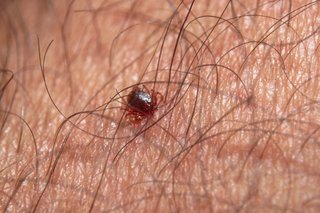
Lyme disease is a bacterial infection that is spread to humans by infected ticks. Ticks are tiny arachnids found in woodland areas that feed on the blood of mammals, including humans.  

Tick bites often go unnoticed and the tick can remain feeding for several days before dropping off. The longer the tick is in place, the higher the risk of it passing on the infection. Read more about the causes of Lyme disease.

Lyme disease can affect your skin, joints, heart and nervous system.  

What are the symptoms of lyme disease?

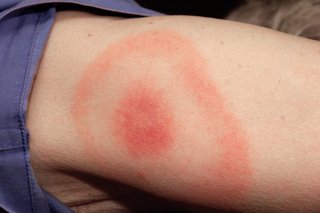
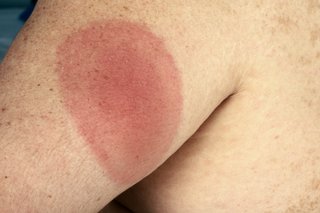
The earliest and most common symptom of Lyme disease is a pink or red circular rash that develops around the area of the bite, three to 30 days after someone is bitten. The rash is often described as looking like a bull’s-eye on a dart board.

You may also experience flu-like symptoms, such as tiredness, headaches and muscle or joint pain.

If Lyme disease is left untreated, further symptoms may develop months or even years later and can include:

  • muscle pain
  • joint pain and swelling of the joints
  • neurological symptoms, such as temporary paralysis of the facial muscles

Lyme disease in its late stages can trigger symptoms similar to those of fibromyalgia or chronic fatigue syndrome. This is known as chronic Lyme disease. More research into this form of Lyme disease is needed.

A person with Lyme disease is not contagious because the infection can only be spread by ticks.

Read more about the symptoms of Lyme disease.

Unless in its early stages when a rash is present, diagnosing Lyme disease is often difficult as many of the symptoms are similiar to those of other conditions. Blood tests are useful and important in acute infection but don't always confirm diagnosis.

Read more about diagnosing Lyme disease.

Diagnosed cases of Lyme disease can be treated with antibiotics. Your course of antibiotics will depend on the stage at which your Lyme disease is at, but you will usually need to take them for two to four weeks.

Read more about treating Lyme disease.

How common is Lyme disease?

Lyme disease is the most common tick-borne infectious disease in Europe and North America. People who spend time in woodland or heath areas are more at risk of developing Lyme disease because these areas are where tick-carrying animals, such as deer and mice, live.

The Health Protection Agency (HPA) estimates that there are 2,000 to 3,000 cases of Lyme disease in England and Wales each year, and that about 15%-20% of cases occur while people are abroad.

Parts of the UK that are known to have a high population of ticks include:

  • Exmoor
  • the New Forest in Hampshire
  • the South Downs
  • parts of Wiltshire and Berkshire
  • Thetford Forest in Norfolk
  • the Lake District
  • the Yorkshire Moors
  • the Scottish Highlands

Most tick bites occur in late spring, early summer and during the autumn because these are the times of year when most people take part in outdoor activities, such as hiking and camping.

Read more about the causes of Lyme disease.

Preventing Lyme disease

There is currently no vaccine to prevent Lyme disease. In 2002, a vaccine was introduced in America but it was later withdrawn due to concerns over side effects.

The best way of preventing Lyme disease is to avoid being bitten when you are in wooded or heath areas known to have a high tick population. The following precautions might help to prevent Lyme disease:

  • Wear a long-sleeved shirt.
  • Tuck your trousers into your socks.
  • Use insect repellent.
  • Check yourself for ticks.
  • Check your children and pets for ticks.

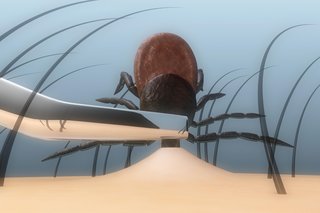
If you do find a tick on your or your child's skin, remove it by gently gripping it as close to the skin as possible, preferably using fine-toothed tweezers, and pull steadily away from the skin.

Never use a lit cigarette end, a match head or essential oils to force the tick out.

Read more about preventing Lyme disease.

Last reviewed: 15/08/2011

Next review due: 15/08/2013

Ratings

How helpful is this page?

Average rating

Based on 171 ratings

All ratings

Add your rating

Comments are personal views. Any information they give has not been checked and may not be accurate.

Gavalin said on 16 May 2013

I have been suffering symptoms of this for over a year now I go fishing every week 3 times a week In woodland and over France 3-4 tines a year where I am constantly bitten to which I shrug off , a year ago now I was admitted to neurology for a week with pressure feeling behind my left eye with fever head ache and numb tingling down left arm and leg after ct MRI scans and other test I was diagnosed with physical migrane fair enough I thought but that was not the end, over next 6 months things got worse with other symptoms showing pain all over my stomach kidney area arm still leg and eye pressure admitted again to hospital ct kidneys scanned with no explanation again, now a year on I am in bits literally my left side is so weak I have started in last 3 months with severe hip pain lower back pain makeing me feel sick, stoke like feeling on left side my face palpitations shortness of breath tiredness what ever it is is ruining my life I have since been to a-e to be told they check my heart nothing else my gp 3 times to have all normal bloods done that dont show this illness as it has to be specifically looked for to which when I mention they shrug off I am 26 and slowly being broken down and stoped from digging my allotment from arthritis like pain I need help and no more know where to turn I wouldn't wish this on anyone, even when I explain that last July I killed a tick on my Bivvy floor while fishing in France and it was full of blood I am not being taken seriously.

Report this content as offensive or unsuitable

Health enthusiast said on 19 April 2013

Many of the comments above indicate that Lyme disease is not easy to diagnose with certainty and treatment is often therefore witheld by the doctor concerned.
One has to realise that a strong course of antibiotics has its negative effects on one's gut flora where your first line of immune defenses lie.
It will tend to weaken you against any number of other opportunistic infections, so a doctor may opt for a cautious approach in the absence of strong evidence of Lyme disease.
If there is doubt, why not try an appropriate herbal natural anti-bacterial product. There are some out there that appear to cure Lyme disease without causing the devastation a potent pharmaceutical antibiotic will.
If the diagnosis is wrong, it will have caused no harm and probably have done you some good in the process.

Report this content as offensive or unsuitable

Elizabass said on 07 December 2012

I live in Vermont, USA and just was diagnosed with Chronic Lyme Disease. No Allopathic medical doctor would test me for Lyme, even though I have felt progressively worse over a period of years. Two weeks ago, a friend recommended a Naturopath, and, based upon my symptoms, this is one of the first tests he ran (but there are different kinds of tests). If you can, find a Naturopath. They don't think things are "all in your head" or that you're a hypochondriac as readily as and MD.

Report this content as offensive or unsuitable

trishsid said on 25 November 2012

2 years ago whilst out walking i was bitten by a tick. About 10-14 days later i started to get flu like symptoms and awful joint pain. About a week after this I went to my GP, he asked me if I had been abroad and if anything had bit me, but I had forgotten about the bite so said no. He ran some blood tests which showed there was something wrong but he didn't know what. By then I had remembered the bite and a Lyme test was done which came back negative. My symptoms have continued since and I have been repeatedly back to my GP to no avail, I have been fobbed off with various things. On my last trip to the doctors I decided to see a different GP, I ended up leaving the surgery in tears as she shouted at me about why I was so convinced I had Lymes and why did I want to be ill. I said all I wanted was to feel well. I feel I have lived two lives, the one previous to this illness,where I was very active, to the one I live now, where I can hardly get my head off the pillow some days. My life has to be planned out now so that I do not do too may things that tire me out. I am now frightened to go to my GP surgery as I feel I have now been labelled a neurotic hypochondriac. Is there anyone to help as I cannot afford to go private .

Report this content as offensive or unsuitable

lynnl said on 14 November 2012

I must add that neither of us were aware of a tick bite or a rash apart from a nasty rash he had on his foot which we put down to a sweat rash through wearing thick socks and motorcycle boots in very hot weather (we were on a motorcycling tour of Montana and Colorado). We did get very badly bitten in Yellowstone but assumed it was mosquitoes.

Report this content as offensive or unsuitable

lynnl said on 14 November 2012

I was very interested to read the above comments.
My husband and myself went to Montana in 2003. Prior to our trip he was happy, healthy and very fit and active. Within 6 months of returning home he had become very withdrawn, sleepy and confused and had episodes of collapse. His GP sent him to a sleep clinic where he was diagnosed with Narcolepsy. Over the last 8 years he has been diagnosed with Narcolepsy, Depression, Dementia with Lewy Bodies, Conversion Disorder (formerly hysteria) and possibly even early Parkinsons. He has seen a succession of Psychologists, Psychiatrists and Neurologists but they have all said that he doesn't fit the criteria for their conditions and have just said it is 'all in his mind'. He remains very sleepy and confused on a 4-weekly cycle with periods in between of complete normality. On his very sleepy and confused days (usually coinciding with full moon) he is almost comatose and unresponsive. if I try to wake him he seems very distant and not at all 'with it'. He has been tested recently for Lyme but it was negative. i have contacted the Yahoo MontanaLyme forum who have been extremely helpful and have suggested many links that may be useful in obtaining a final diagnosis and treatment.
Is there anybody who could give me the name of a doctor who is an LLMD as most GP's and consultants seem to believe that I am neurotic and my husband is manufacuring his condition to avoid having to do things he does not want to.
I am mostly certainly not neurotic. i am a very level-headed and calm woman who just wants her husband the way he was before we went to the States. i must add that we love the States and fully intend to return as soon as possible. We do not hold Montana responsible for his condition even though he probably contracted it there.

Report this content as offensive or unsuitable

jas1957 said on 21 June 2012

Recently I have been able to use the Lyme disease map of medicine to argue that I have NOT been given the recommended treatment for Lyme disease. Previously my doctor insisted that oral antibiotics were more than adequate despite my having central nervous system involvement. I have now just finished a 21 day course of intravenous Ceftriaxone.

This map of medicine was due to be reviewed at the end of May 2012. Instead it has been removed from this site. When I asked why I was sent the following message.

"The aim of the Map of Medicine is to offer pathways that will be of
value to our users, and reflect how clinical topics are dealt with in
clinical practice. In accordance with our methodology we have analysed
key data to determine the justification for the Lyme disease pathway,
balanced against the resource requirements to maintain it and its
anticipated use. The outcome of this analysis is that we have decided
not to retain and update this topic currently. However, if circumstances
change in the future, we will be sure to republish the pathway."

In view of the woeful lack of knowledge about Lyme disease of most doctors I would argue that this guide is very much needed.

Report this content as offensive or unsuitable

jacqui39 said on 11 June 2012

I was diagnosed 25yrs ago as having ME-later tested privately and it was discovered it was Lyme disease. All I can say is that I am appalled at the lack of doctors knowledge about this illness. Because of their ignorance/misdiagnosis of this uillness I have ended up with severe arthritis-had 3 operations-no good-I now have to have special boots and insoles made at HRI and poditry treatment every 8wks. Two specialists recently have denied one can have chronic Lyme disease and refused antibiotic treatment. I have read of numerous patients committing suicide and I am not surprised- when one is treated as if we are just imaging all the pain etc. It is the young ones that I feel sorry for-they have had no life.

Report this content as offensive or unsuitable

Gizz47 said on 28 May 2012

"Ticks are tiny, spider-like insects"

.... No they're not. They are arachnids, *not* insects.
6 legs = insect. 8 legs = arachnid. Come on NHS: that's primary school biology!

Report this content as offensive or unsuitable

donola said on 08 September 2011

I'm going to answer my own question. I have E-mailed the 'Lyme Disease Research Database' in the States with the same question and received the following reply.

To answer your question, no. Ticks are not the only creatures who can carry Lyme bacteria. The bacteria which causes the Lyme infection has been detected in other insects such as mosquitoes that are blood sucking.

Report this content as offensive or unsuitable

donola said on 07 September 2011

I would like to just tadd more to my previous post and detail of my experience: I am from Salisbury , wiltshire. Which is where i do all my walking.

I was recently diagnosed with Lyme disease, with the symptons of a bull-ring rash and a sore foot .
The sore foot, I had had for about 4 months ( i know this , because i thought it was a sporting injury which hampered my running). About 2 months later i was Biten badly over night in MANY places by an insect while in my bed. One of the bites became quite sore and did not disappear , around this bite developed my classic bull ring rash(7 inch diameter).

When i went to my doctors after about six weeks of the start of the rash, I told the doctor of my two ailments, and after later reading, realise I was lucky, to have such an astute examiner. Was blood tested, proscribed doxcycycline, and 3 days later my rash was disappearing and my 6 month foot injury had completely gone.

My question is, what triggered the rash , when I know that was a secondary bite ? I had obviously been affected atleast 2 months prior to that bite,.... Or is it, that that was actually my secondary infection, and that other blood sucking insects carry Lyme in smaller dosages.aswell. ...... ands that what made me react to a Non Tic- bite. ( which is undoubtly and unquestionbly the case, that it wasn't a Tic).

Report this content as offensive or unsuitable

donola said on 05 September 2011

Is it absolutely the only way to get infected by a Tick bite. No ever blood sucking insect. I currently have Lyme disesase. And my rash formed around an area of Particular nasty bite ( one out of a series of about a dozen bites) I received from i presumed was a particular nasty looking insect I found on my bed on that morning.

Report this content as offensive or unsuitable

User506239 said on 30 November 2010

An American MD (Alan MacDonald) has discovered a link between Lyme disease and various neurological conditions including MS, Parkinsons and Dementia.

He noted that Syphillis (known at one time as the "great pretender" because it mimicked many diseases) could produce symptoms similar to MS, Dementia and Parkinsons. As Syphillis was caused by a spirochete bacterium he investigated whether MS, Parkinsons and Dementia could also be caused by a spirochete. Using DNA techniques he found the Lyme disease spirochete was present in most of the cases he examined!

This is an area that needs more research and perhaps blood samples of individuals with MS, Parkinsons and Dementia should be routinely screened using Stevenel Blue for microscopial contrast ( instead of DNA )

Report this content as offensive or unsuitable

whitehorses said on 04 September 2010

It's odd that the above data says that Lymes is uncommon as I know 4 people locally who have been treated for it over the last 12 months, myself included. OK 3 of them, including myself , picked the up the infection abroad: 2 whilst walking in in the Belgium Ardennes, & 1 walking in Canada; the home grown infection was by a friend surveying a forested site in Wiltshire. I have a bad feeling that Lymes is going undiagnosed. Data from the US Surgeon General's website is far better than on this NHS site and, if you're sports or work involve involve the countryside, you need to be aware of the symptoms..

Report this content as offensive or unsuitable

kayjays said on 04 August 2010

Include areas of Wales please.
Ixodes ricinus, (castor bean tick) is endemic in upland areas of Wales. Certainly at the Western end of the Brecon Beacons N.Park.
Lyme disease has been undiagnosed for many years due to the lack of information concerning the presence of this carrier vector.

Report this content as offensive or unsuitable

scLyme said on 10 July 2009

For those worried about Lyme Disease and tick borne infection, further information available at: http://www.lymediseaseaction.org.uk/ and check out the 16th Edition of Joseph Burrascano's paper on the subject: www.lymenet.org/BurrGuide200810.pdf
Bulls-eye rash may only to appear in less than 50% of cases.

Report this content as offensive or unsuitable

Travel health

Advice for people travelling abroad, including malaria, travel vaccinations, EHIC, travel insurance, DVT and jet lag

Find and choose services for Lyme disease