Every baby is offered newborn blood spot screening, also known as the heel prick test, ideally when they're 5 days old.
What is the blood spot test?
Newborn blood spot screening involves taking a blood sample to find out if your baby has 1 of 9 rare but serious health conditions.
Most babies won't have any of these conditions but, for the few who do, the benefits of screening are enormous.
Early treatment can improve their health, and prevent severe disability or even death.
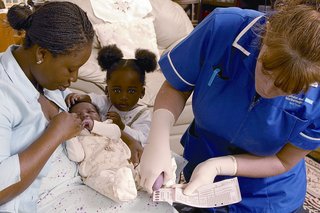
What does the blood spot test involve?
When your baby is 5 days old, a healthcare professional will prick their heel and collect 4 drops of blood on a special card.
You can ease any distress for your baby by cuddling and feeding them, and making sure they're warm and comfortable.
Occasionally, the sample may need to be taken when your baby is 6, 7 or 8 days old.
Sometimes a second blood spot sample is needed. The reason for this will be explained to you. It doesn't necessarily mean there's something wrong with your baby.
The test doesn't carry any known risks for your baby.
Which conditions is the blood spot test for?
The blood spot test screens for the following 9 rare but serious conditions.
If you, your partner or a family member already has one of these conditions (or a family history of it), tell your healthcare professional straight away.
Sickle cell disease
About 270 babies are born with sickle cell disease in the UK each year. This is a serious inherited blood disease.
Sickle cell disease affects haemoglobin, the iron-rich protein in red blood cells that carries oxygen around the body.
Babies who have this condition will need specialist care throughout their lives.
People with sickle cell disease can have attacks of severe pain and get serious, life-threatening infections. They're usually anaemic because their blood cells have difficulty carrying oxygen.
The blood spot screening test means that babies with sickle cell disease can receive early treatment to help them live healthier lives. This may include vaccinations and antibiotics to prevent serious illnesses.
Pregnant women are also routinely tested for sickle cell disease early in pregnancy.
Read more about sickle cell disease.
GOV.UK also has a factsheet about sickle cell disease
Cystic fibrosis
About 1 in 2,500 babies born in the UK has cystic fibrosis. This inherited condition affects the digestion and lungs.
Babies with cystic fibrosis may not gain weight well and are prone to chest infections.
Babies with the condition can be treated early with a high-energy diet, medicines and physiotherapy.
Although children with cystic fibrosis may still become very ill, early treatment can help them live longer, healthier lives.
Read more about cystic fibrosis.
GOV.UK also has a leaflet for parents whose baby has suspected cystic fibrosis
Congenital hypothyroidism
About 1 in every 2,000 to 3,000 babies born in the UK has congenital hypothyroidism. Babies with congenital hypothyroidism don't have enough of the hormone thyroxine.
Without thyroxine, babies don't grow properly and can develop learning disabilities.
Babies who have the condition can be treated early with thyroxine tablets, and this allows them to develop normally.
The British Thyroid Foundation has more information about congenital hypothyroidism
Inherited metabolic diseases
It's important to let your healthcare professional know if you have a family history of a metabolic disease (a disease that affects your metabolism).
Babies are screened for 6 inherited metabolic diseases. These are:
- phenylketonuria (PKU)
- medium-chain acyl-CoA dehydrogenase deficiency (MCADD)
- maple syrup urine disease (MSUD)
- isovaleric acidaemia (IVA)
- glutaric aciduria type 1 (GA1)
- homocystinuria (pyridoxine unresponsive) (HCU)
About 1 in 10,000 babies born in the UK has PKU or MCADD. The other conditions are rarer, occurring in 1 in 100,000 to 150,000 babies.
Without treatment, babies with inherited metabolic diseases can become suddenly and seriously ill. The diseases all have different symptoms.
Depending on which one affects your baby, the condition may be life threatening or cause severe developmental problems.
They can all be treated with a carefully managed diet and, in some cases, medicines as well.
Severe combined immunodeficiency (SCID)
In some areas of England, screening for a condition called severe combined immunodeficiency (SCID) is also being offered as part of the newborn blood spot test. This is to help the NHS decide if screening for SCID should be offered to all babies in England.
SCID causes problems with the immune system. It makes it very hard for a baby to fight off infections like meningitis and pneumonia, which can be life-threatening. About 14 babies born each year in England have SCID.
Ask your midwife if screening for SCID is being offered in your area.
Great Ormond Street Hospital for Children has more information on severe combined immunodeficiency
Does my baby have to have the blood spot test?
The blood spot test is not compulsory, but it's recommended because it could save your baby's life.
You can choose to have screening for sickle cell disease, cystic fibrosis or congenital hypothyroidism individually, but you can only choose to have screening for all 6 inherited metabolic diseases or none at all.
If you don't want your baby to be screened for any of these conditions, discuss it with your midwife.
You should be given information about the blood spot test and the diseases it screens for in advance so you can make an informed decision for your baby.
If you change your mind, babies can be screened up to the age of 12 months for all the conditions except cystic fibrosis. Cystic fibrosis can only be screened for up to 8 weeks of age.
If you have any concerns about the tests, speak to your midwife, health visitor or GP.
When will we get the results?
You should receive the results either by letter or from a healthcare professional by the time your baby is 6 to 8 weeks old.
The results should be recorded in your baby's personal child health record (red book). It's important to keep this safe and take it with you to all your baby's appointments.
If you haven't received your baby's results, speak to your health visitor or GP.
You'll be contacted sooner if your baby screens positive. This means they're more likely to have one of the conditions tested for.
You'll be contacted:
- the day the result is available, or the next working day, if your baby is thought to have congenital hypothyroidism (CHT) – you'll be given an appointment to see a specialist
- before your baby's 4 weeks old if they're thought to have cystic fibrosis
- before your baby's 6 weeks old if they're thought to have sickle cell disease
Screening for cystic fibrosis finds some babies who may be genetic carriers of the condition. These babies may need further testing.
Screening for sickle cell disease also finds babies who are carriers of this or other red blood cell diseases.
Carriers are healthy, although they can experience problems in situations where their bodies aren't getting much oxygen – for example, if they're having an anaesthetic.
Parents of babies who are found to be carriers should be told by the time they're 6 to 8 weeks old.
What do the results mean?
Most babies will have a normal result, which means it's unlikely that they have any of the conditions.
A small number of babies will screen positive for one of the conditions. This doesn't mean they have the condition, but they're more likely to have it. They'll be referred to a specialist for more tests.
It's important to know that screening isn't 100% certain. A baby with a negative screening result may later turn out to have the disease screened for. This is known as a false negative.
Babies with a positive result sometimes turn out not to have the disease – what's known as a false positive.
Occasionally, other medical conditions are picked up by blood spot test screening. For example, babies with beta thalassaemia major, a serious blood disease, will usually be detected. These babies also need to be referred for early treatment.