The newborn hearing screening test helps identify babies who have permanent hearing loss as early as possible. This means parents can get the support and advice they need right from the start.
Hearing loss in babies
1 to 2 babies in every 1,000 are born with permanent hearing loss in 1 or both ears.
This increases to about 1 in every 100 babies who have spent more than 48 hours in intensive care.
Most of these babies are born into families with no history of permanent hearing loss.
Permanent hearing loss can significantly affect babies' development.
Finding out early can give these babies a better chance of developing language, speech and communication skills.
It will also help them make the most of relationships with their family or carers from an early age.
When is the newborn hearing test done?
If you give birth in hospital, you may be offered a newborn hearing test for your baby before you're discharged.
Otherwise it will be done by a healthcare professional, healthcare assistant or health visitor within the first few weeks.
You'll be contacted by your local newborn hearing screening service to arrange a suitable time and venue.
Ideally, the test is done in the first 4 to 5 weeks, but it can be done at up to 3 months of age.
If you're not offered a screening test, ask your health visitor, local audiology department or GP to arrange an appointment, or contact your local newborn hearing screening service.
How is the newborn hearing test done?
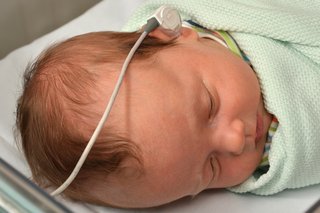
The newborn hearing test is called the automated otoacoustic emission (AOAE) test. It takes just a few minutes.
A small soft-tipped earpiece is placed in your baby's ear and gentle clicking sounds are played.
It's not always possible to get clear responses from the 1st test. This happens with lots of babies, and does not always mean your baby has permanent hearing loss.
It could mean:
- your baby was unsettled when the test was done
- there was background noise
- your baby has fluid or a temporary blockage in their ear
In these cases, your baby will be offered a 2nd test. This may be the same as the 1st test, or another type called the automated auditory brainstem response (AABR) test.
The AABR test involves placing 3 small sensors on your baby's head and neck. Soft headphones are placed over your baby's ears and gentle clicking sounds are played. This test takes between 5 and 15 minutes.
These tests will not harm your baby in any way.
Does my baby have to have the newborn hearing test?
The newborn hearing test is highly recommended, but it's not compulsory. If you decide not to have the screening test, you'll be given checklists to help you check on your baby's hearing as they grow older. If you have any concerns, speak to your health visitor or GP.
When will we get the results?
You'll be given your baby's hearing test results as soon as the test is done. If your baby has a clear response in both ears, they're unlikely to have permanent hearing loss.
But the newborn hearing test does not pick up all types of permanent hearing loss. Children can also develop permanent hearing loss later on, so it's important to check your child's hearing as they grow up.
The checklist in your baby's personal child health record (red book) tells you how to do this.
You can also visit Newborn hearing screening: making and reacting to sounds checklists on GOV.UK.
If you have any concerns about your child's hearing, tell your health visitor or GP.
What does it mean if my baby is referred to a hearing specialist?
If the screening test results do not show a clear response from 1 or both of your baby's ears, an appointment will be made with a hearing specialist at an audiology clinic.
Even if this happens, it does not necessarily mean your baby has permanent hearing loss.
A hearing specialist should see you within 4 weeks of your baby's hearing test.
It's important that you attend the appointment in case your baby does have permanent hearing loss.
The appointment will usually take about 1 to 2 hours. This includes time to settle your baby.
If possible, feed your baby shortly before the hearing test. Make sure you have everything you need to keep them comfortable and happy.
The tests give more detailed information about your baby's hearing. They will not hurt or be uncomfortable for your baby, and you'll be able to stay with them while the tests are done.
You may want to take your partner or a friend or relative with you to the appointment.
The audiologist will usually be able to give you the results at the end of the appointment. They'll explain what the results mean for your baby's hearing and whether they need any more tests.
What does it mean if my baby has permanent hearing loss?
Types and levels of permanent hearing loss vary. Each baby's hearing loss will be different.
Support and information is available, including leaflets on the different types of hearing loss:
- GOV.UK: confirmed hearing loss in babies
- GOV.UK: confirmed hearing loss in one ear
- GOV.UK: confirmed mild hearing loss in babies
You can also contact the National Deaf Children's Society (NDCS) freephone helpline on 0808 800 8880 (voice and text).
Video: Newborn hearing screening
This video describes what newborn hearing screening is, and highlights its importance.
Media review due: 4 August 2024