Nutrition information labels can help you choose between products and keep a check on the amount of foods you're eating that are high in fat, salt and added sugars.
All pre-packed foods have a nutrition information label on the back or side of the packaging.
You can use nutrition information labels to help you eat a balanced diet.
If you're choosing foods and drinks that are high in fat, salt and sugar, have these less often and in small amounts.
Most people in the UK eat and drink too many calories, have too much fat, sugar and salt, and not enough fruit, vegetables, oily fish or fibre.
Nutrition information labels on the back or side of packaging
All pre-packed foods have a nutrition information label on the back or side of the packaging. These labels must include the amount of energy in kilojoules (kJ) and kilocalories (kcal), usually referred to as calories.
They must also include information on fat, saturates (saturated fat), carbohydrate, sugars, protein and salt. They may also include other nutrients, like fibre.
All nutrition information is provided per 100 grams or per 100 millilitres and sometimes per portion of the food or drink.
How do I know if a food is high in fat, saturated fat, sugar or salt?
There are guidelines to tell you if a food is high in fat, saturated fat, salt, sugar or not.
These are:
Total fat
High: more than 17.5g of fat per 100g
Low: 3g of fat or less per 100g
Saturated fat
High: more than 5g of saturated fat per 100g
Low: 1.5g of saturated fat or less per 100g
Sugars
High: more than 22.5g of total sugars per 100g
Low: 5g of total sugars or less per 100g
Salt
High: more than 1.5g of salt per 100g (or 0.6g sodium)
Low: 0.3g of salt or less per 100g (or 0.1g sodium)
For example, if you're trying to cut down on saturated fat, eat fewer foods that have more than 5g of saturated fat per 100g.
Different criteria are used to determine whether a drink is high or low in fat, saturated fat, sugar or salt.
Some nutrition information labels on the back or side of packaging also provide information about reference intakes.
Nutrition labels on the front of packaging
Many supermarkets and food manufacturers now also highlight the energy, fat, saturated fat, sugars and salt content on the front of the packaging, alongside the reference intake for each of these.
This is very useful when you want to compare different food and drink products at a glance.
Front-of-pack labels usually give a quick guide to:
- energy (calories)
- fat content
- saturated fat content
- sugars content
- salt content
These labels provide information on the number of grams of fat, saturated fat, sugars and salt, and the amount of energy (in kJ and kcal) in a serving or portion of the food or drink. It may also provide the amount of kJ and kcal per 100g or per 100ml.
But be aware that the manufacturer's idea of a portion may be different from yours.
Some front-of-pack nutrition labels also provide information about reference intakes.
Red, amber and green colour coding
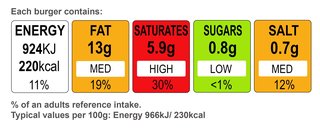
Some front-of-pack nutrition labels use red, amber and green colour coding.
Colour-coded nutritional information tells you at a glance if the food has high, medium or low amounts of fat, saturated fat, sugars and salt:
- red means high
- amber means medium
- green means low
In general, a food or drink that has all or mostly green on the label is a healthier choice.
Amber means neither high nor low, so you can eat foods with all or mostly amber on the label most of the time.
But any red on the label means the food is high in fat, saturated fat, salt or sugars, and you should limit your intake of these foods and drinks.
Try to eat these foods less often and in small amounts.
Reference intakes
Nutrition labels can also provide information on how a particular food or drink product fits into your daily recommended diet.
Reference intakes are guidelines about the approximate amount of particular nutrients and energy required for a healthy diet.
Ingredients list
Pre-packed food products must have a list of ingredients with allergens highlighted in bold on the packaging or an attached label.
The ingredients list can also help you work out how healthy the product is.
Ingredients must be listed in descending order of weight, so the main ingredients in the packaged food always come first.
That means that if the first few ingredients are high-fat ingredients, such as cream, butter or oil, then the food in question is likely to be a high-fat food.
Food shopping tips
You're standing in the supermarket aisle looking at 2 similar products, trying to decide which to choose. You want to make the healthier choice, but you're in a hurry.
If you're buying pre-packaged or ready meals, check to see if there's a nutrition label on the front of the pack, and then see how your choices stack up when it comes to the amount of energy, fat, saturated fat, sugars and salt.
If the nutrition labels use colour coding, you'll often find a mixture of red, amber and green.
So when you're choosing between similar products, try to go for more greens and ambers, and fewer reds, if you want to make a healthier choice.